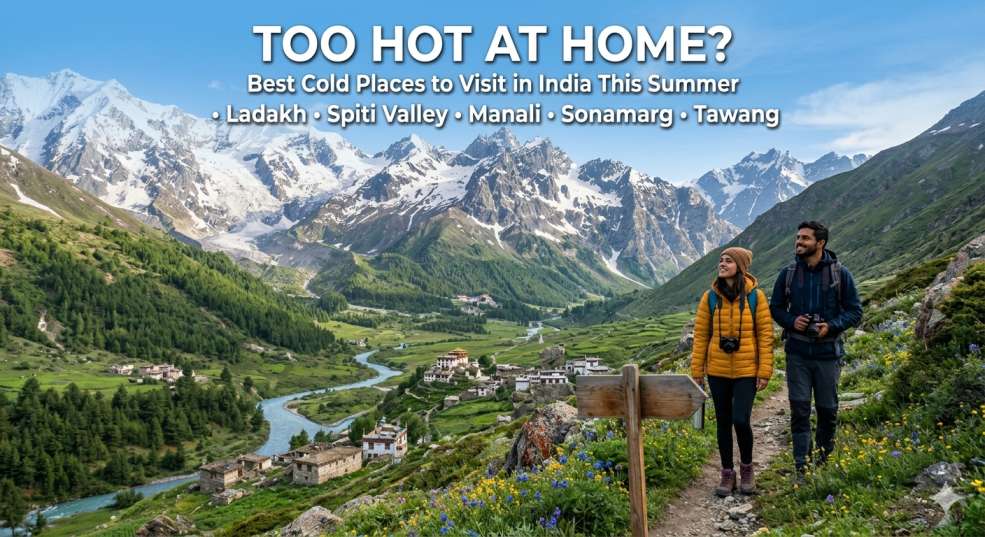
Why Escape This Summer?

India's summer of 2026 is unforgiving. The plains — from Rajasthan to Uttar Pradesh to Telangana — are baking at 40–47°C, and the heat index makes it feel even worse. If you're in Goa, you know the sticky humidity between May and June makes outdoor life nearly impossible.

The good news? India's extraordinary geography gives you a stunning range of cool retreats. From the sub-zero nights of Dras in Jammu & Kashmir to the misty tea gardens of Munnar in Kerala, there's a cold destination for every type of traveller — family, solo, adventure-seeker, or honeymooner.

We've curated the 10 best cold places to visit in India this summer, complete with real temperature data, what to do, and practical travel tips so you can plan your escape today.

🗺️ Quick Summer 2026 Stats

10+
Cool Destinations
5°C
Coldest (Dras)
25°C
Warmest on List
3,500m
Avg Altitude

10 Best Cold Places in India — Summer 2026

Ranked from most extreme cold to pleasant cool — choose your adventure level!

1

Leh-Ladakh, Jammu & Kashmir

Jammu & Kashmir · 3,500m above sea level
❄️ 5–15°C in June–August

Ladakh is the crown jewel of Indian summer escapes — a high-altitude cold desert where the skies are impossibly blue, the mountains jaw-dropping, and the air refreshingly crisp even in peak summer. While the rest of India swelters, Ladakh sits at a cool 5–15°C, with nights occasionally dipping toward freezing.

The legendary Pangong Tso Lake shifts through extraordinary shades of turquoise and sapphire, while Nubra Valley offers the surreal sight of golden sand dunes backdropped by snow-capped peaks. The magnetic hill, Hemis Monastery, and the Khardung La Pass — one of the world's highest motorable roads — are must-visits.

🏔️ Pangong Tso Lake
🐫 Nubra Valley
🛕 Hemis Monastery
🛣️ Khardung La Pass
✓ Open May–Oct Adventure Plan 7–10 days
2

Spiti Valley, Himachal Pradesh

Himachal Pradesh · 3,800m above sea level
❄️ 10–18°C in June–August

Often called "Little Tibet," Spiti Valley is an isolated, high-altitude cold desert that opens fully only from late May each year. While most of India hits 45°C, Spiti stays at a comfortable 10–15°C — enough to need a light jacket at all times. The landscape is raw and otherworldly: ochre mountains, ancient Buddhist monasteries perched on cliffsides, and crystal-clear rivers.

Key Pin Valley National Park is a biodiversity hotspot — spot snow leopards, Tibetan wolves, and ibex. The Key Monastery (Ki Gompa), dating back to the 11th century, is one of the most photographed spots in India. Roads are rough — an SUV is highly recommended.

🧘 Key Monastery
🦁 Snow Leopard Trails
🌌 Stargazing
🚵 Motorbike Trails
✓ Open May–Oct Offbeat 5–7 days
3

Gulmarg, Jammu & Kashmir

Baramulla District · 2,650m above sea level
❄️ 10–20°C in May–August

Gulmarg — meaning "Meadow of Flowers" — transforms into a paradise of wildflowers and lush green slopes in summer. One of the coldest summer destinations in India, it offers crisp mountain air and world-class adventure at the same time. The famous Gulmarg Gondola (Asia's highest cable car) takes you to Apharwat Peak at 3,980m for panoramic views of the Kashmir Valley.

In summer 2026, the meadows are alive with multicolored flowers — ideal for nature photography. Golfing at one of the world's highest golf courses, trekking to Alpather Lake, and horse-riding across the meadows are popular activities. Carry a rain jacket as weather shifts quickly.

🚡 Gondola Ride
🌸 Wildflower Meadows
High-Altitude Golf
🏔️ Apharwat Peak
✓ Year-Round Family-Friendly 3–4 days
4

Manali, Himachal Pradesh

Kullu District · 2,050m above sea level
🌤️ 10–25°C in May–August

India's most popular summer hill station, Manali, needs no introduction. With snow-capped peaks visible from the town centre, pine-forested valleys, and the Beas River rushing through, it's a perfect blend of accessibility and natural beauty. In 2026, new eco-tourism initiatives make the experience richer and more sustainable.

Solang Valley offers paragliding, zorbing, and jeep safaris over rocky terrain. The dramatic Rohtang Pass (accessible by permit) offers snow even in July. The quirky Old Manali town is lined with cafes, artisan shops, and a fantastic nightlife scene perfect for younger travellers.

🪂 Paragliding
🏔️ Rohtang Pass
🛕 Hidimba Temple
🚗 Solang Valley
✓ April–October All Traveller Types 4–6 days
5

Tawang, Arunachal Pradesh

Tawang District · 3,048m above sea level
❄️ Below 10°C in summer nights

Tawang is one of India's coldest places even in peak summer — daytime highs hover around 20°C while nights often drop close to 10°C. Nestled in the eastern Himalayas near the Bhutan and Tibet borders, it's one of India's most breathtaking and underrated destinations. The Tawang Monastery — the largest Buddhist monastery in India — is a spiritual and architectural marvel that draws pilgrims and photographers alike.

Green valleys dotted with wildflowers, mountain lakes like Sela Pass and Madhuri Lake, and the remote Bumla border pass with China are among the extraordinary attractions. Inner Line Permits are required — plan ahead.

🙏 Tawang Monastery
🌊 Sela Pass Lake
📸 Madhuri Lake
🌄 Bumla Border Pass
✓ April–Oct (ILP needed) Offbeat & Spiritual 5–7 days
6

Munnar, Kerala

Idukki District, Western Ghats · 1,600m above sea level
🌿 15–25°C in May–August

Munnar is South India's most celebrated hill station — and for good reason. Its rolling hills blanketed in lush tea estates, misty valleys, and the scent of fresh tea leaves make it one of India's most scenic retreats. With temperatures staying between 15–25°C even in peak summer, it's a world apart from the coastal heat of Kerala.

Visit Eravikulam National Park — home to the rare Nilgiri Tahr mountain goat — or trek to the highest peak in South India, Anamudi (2,695m). The area is also India's largest tea-growing region, and factory tours are fascinating. Book accommodations well in advance as summer is peak season.

🍵 Tea Plantation Tours
🦌 Eravikulam NP
🥾 Anamudi Trekking
🌊 Attukal Waterfalls
✓ Year-Round (monsoon Apr–Jun) Couples & Families 3–4 days
7

Darjeeling, West Bengal

West Bengal · 2,042m above sea level
🌤️ 15–22°C in May–August

The "Queen of the Hills" blends colonial charm, Himalayan grandeur, and world-famous tea into an irresistible summer escape. On a clear morning, the view of Kanchenjunga (the world's third-highest peak) from Tiger Hill at sunrise is one of India's most iconic sights. The famous Darjeeling Himalayan Railway — a UNESCO World Heritage toy train — winds through breathtaking mountain scenery.

The bustling Chowrasta mall, the historic Observatory Hill temple, and the serene Peace Pagoda make Darjeeling a rich cultural experience alongside its natural beauty. Tea lovers can tour the famous Happy Valley Tea Estate.

🚂 Toy Train (UNESCO)
🌄 Tiger Hill Sunrise
🍵 Happy Valley Tea
🏔️ Kanchenjunga View
✓ March–June, Sep–Nov Heritage & Culture 3–4 days
8

Meghalaya (Shillong & Cherrapunji)

Northeast India · 1,500m above sea level
🌧️ 18–24°C · World's Wettest Region

Meghalaya — meaning "Abode of Clouds" — is one of India's most magical states, especially in summer when waterfalls are at full force and the landscape turns a lush, electric green. Cherrapunji (Sohra), one of the wettest places on Earth, is home to the extraordinary Living Root Bridges — ancient single and double-decker bridges naturally grown from tree roots over centuries.

Shillong, the state capital, offers a cool and culturally vibrant city experience with excellent music, food, and proximity to the stunning Dawki River (so clear you can see the riverbed) and Mawlynnong — Asia's cleanest village. Plan flexible itineraries as summer rains can delay travel.

🌿 Living Root Bridges
🌊 Nohkalikai Falls
🏞️ Dawki Crystal River
🏘️ Mawlynnong Village
✓ Oct–May (Pre-heavy monsoon) Adventure & Culture 4–5 days
9

Coorg (Kodagu), Karnataka

Western Ghats · 1,525m above sea level
🌿 15–25°C in May–August

Known as the "Scotland of India," Coorg is a misty, green paradise of coffee plantations, spice gardens, and rain forests. This hidden gem in the Western Ghats offers some of South India's best summer weather — consistently between 15–25°C. The region's Kodava culture, distinct cuisine (pandi curry, nool puttu), and warm hospitality add to its appeal.

Activities include elephant encounters at Dubare Elephant Camp, white-water rafting on the Barapole River, trekking to Tadiandamol Peak (the highest in Coorg), and exploring the historic Madikeri Fort. Coffee estate stays offer an unforgettable farm-to-cup experience.

🐘 Dubare Elephant Camp
Coffee Estate Stays
🥾 Tadiandamol Trek
🏰 Madikeri Fort
✓ Oct–June Best Romantic & Families 3–4 days
10

Mount Abu, Rajasthan

Sirohi District · 1,220m above sea level
🌤️ 20–28°C in May–August

The only hill station in Rajasthan, Mount Abu is a lifeline for anyone trapped in the state's extreme desert summer. While Jaipur and Jodhpur bake at 44°C, Mount Abu sits at a comfortable 20–28°C — a full 15 degrees cooler. The town itself is built around the picturesque Nakki Lake, where boat rides offer a relaxing escape.

The exquisite Dilwara Jain Temples (11th–13th century) with their intricate marble carvings are considered among the finest examples of Jain architecture in the world. Guru Shikhar — the highest peak in the Aravalli Range — offers panoramic views. A fantastic, accessible escape from Goa or Rajasthan's plains with excellent road connectivity.

🛕 Dilwara Temples
Nakki Lake Boating
🏔️ Guru Shikhar Peak
🌅 Sunset Point
✓ Year-Round Easy Accessibility 2–3 days

Quick Comparison: Best Cold Places in India Summer 2026

Destination State Summer Temp Difficulty Best For Rating
Leh-Ladakh J&K 5–15°C Challenging Adventure, Photography ★★★★★
Spiti Valley Himachal 10–18°C Hard Roads Offbeat, Culture ★★★★★
Gulmarg J&K 10–20°C Easy Family, Adventure ★★★★★
Manali Himachal 10–25°C Easy All Types ★★★★☆
Tawang Arunachal <10°C nights Moderate Spiritual, Offbeat ★★★★★
Munnar Kerala 15–25°C Easy Couples, Families ★★★★☆
Darjeeling West Bengal 15–22°C Easy Heritage, Culture ★★★★☆
Meghalaya Northeast 18–24°C Moderate Nature, Adventure ★★★★★
Coorg Karnataka 15–25°C Easy Romance, Wellness ★★★★☆
Mount Abu Rajasthan 20–28°C Easy Families, Quick Trip ★★★★☆

🧳 Essential Summer Travel Tips for Cold Places in India

1

Acclimatize at high altitudes: For places above 3,000m (Ladakh, Spiti, Tawang), spend your first day resting and drinking lots of water. Altitude sickness is real — ascend slowly and carry altitude medication like Diamox if recommended by your doctor.

2

Book accommodation early: Summer is peak season for most cold hill stations. Hotels in Manali, Munnar, and Darjeeling fill up weeks in advance. Book by March–April for May–June travel.

3

Pack layered clothing: Even the "warmer" destinations on this list (Munnar, Coorg) can get chilly at night. Pack thermal inners, a mid-layer fleece, and a waterproof outer shell. Avoid cotton in high-altitude cold zones.

4

UV protection is critical: UV rays are 2–3× more intense at high altitudes. Apply SPF 50+ sunscreen every 2 hours, wear sunglasses with UV400 protection, and use a wide-brimmed hat — even on cloudy days.

5

Stay hydrated: Cold, dry mountain air causes rapid dehydration even when you don't feel thirsty. Drink at least 3–4 litres of water daily at altitude. Avoid alcohol on your first 48 hours at altitude.

6

Check for permits: Destinations like Tawang (Arunachal Pradesh) require an Inner Line Permit (ILP) for non-Arunachali Indian citizens. Spiti and certain areas near the Line of Actual Control have special permit rules. Apply online in advance.

7

Prefer morning travel: Mountain roads are safest in the morning before afternoon clouds and rains set in. Start driving early, and always avoid driving mountain roads at night.


Frequently Asked Questions

Quick answers to the most common questions about cold places in India this summer.

Which is the coldest place in India to visit in summer 2026?
Dras in Jammu & Kashmir is technically the coldest, with summer nights dipping to around -5°C even in June. Among more accessible destinations, Tawang in Arunachal Pradesh stays below 10°C even during summer days. Ladakh and Spiti Valley are the most popular extreme-cold summer destinations at 5–15°C.
Manali, Munnar, Darjeeling, Gulmarg, and Mount Abu are ideal for families — they have good road connectivity, a wide range of accommodation options, kid-friendly activities, and excellent infrastructure. Ladakh and Spiti Valley are better for older children and adults due to high altitude.
Yes, Ladakh is safe for first-timers in summer — May to September is the main tourist season with open roads and stable weather. However, altitude sickness is the biggest concern. Fly into Leh (don't drive directly), spend your first day resting, and acclimatize for at least 24–48 hours before any excursion. Always carry altitude medication.
Munnar in Kerala and Ooty in Tamil Nadu are the coldest summer destinations in South India, typically at 15–25°C. Coonoor (Tamil Nadu) and Coorg (Karnataka) are other excellent options. For the absolute coolest South Indian experience, the Nilgiri Hills — covering parts of Kerala, Tamil Nadu, and Karnataka — offer the most consistently pleasant summer temperatures in the south.
Pack thermal inners, a mid-layer fleece or sweater, a waterproof jacket, comfortable hiking shoes with grip, UV-protective sunglasses (polarized is better at altitude), SPF 50+ sunscreen, and a reusable water bottle. For high-altitude destinations above 3,000m, also carry altitude medication (consult your doctor), lip balm (dry air chaps lips quickly), and a basic first-aid kit. Avoid cotton base layers at extreme altitudes — they absorb moisture and cool you down dangerously.
Goa in May–June 2026 sees temperatures of 32–38°C with very high humidity, making outdoor activities quite uncomfortable. Most beaches and tourist spots are quiet during this period. If you're based in Goa and want a summer escape, the best cold places accessible from Goa include Coorg (6–7 hours), Munnar (10–11 hours), and Mahabaleshwar in Maharashtra (~8 hours). Flying to Manali, Ladakh, or Darjeeling is also straightforward from Goa Airport.

🎒 Ready to Beat the Heat?

India's summer doesn't have to mean suffering indoors under a fan. Whether you're chasing snowline adventures in Ladakh, misty morning walks in a Munnar tea garden, or the surreal silence of a Spiti Valley monastery, there's a perfect cold escape waiting for you this summer 2026.

Start planning early, book ahead, and carry layers — because the mountains don't care what month it is on the plains. Stay cool, stay safe, and explore incredible India! 🇮🇳