How Much Electricity Does an AC Use?
Key Takeaways
- Formula: Electricity used (kWh) = Power (kW) × Hours run — this works for any AC, anywhere.
- Typical 1.5 ton AC: roughly 1–1.8 kWh per hour, depending on star rating, inverter technology, and settings.
- The biggest lever you control: temperature setting — every degree lower makes the compressor work harder and longer.
- Maintenance matters as much as specs — a dirty filter or coil can raise consumption on a unit whose rated power hasn't changed at all.
- Inverter ACs save the most on long, continuous runs (overnight, all-day); the gap narrows for short, intermittent use.

Watch: what actually determines your AC's electricity use.
How AC Electricity Consumption Is Calculated
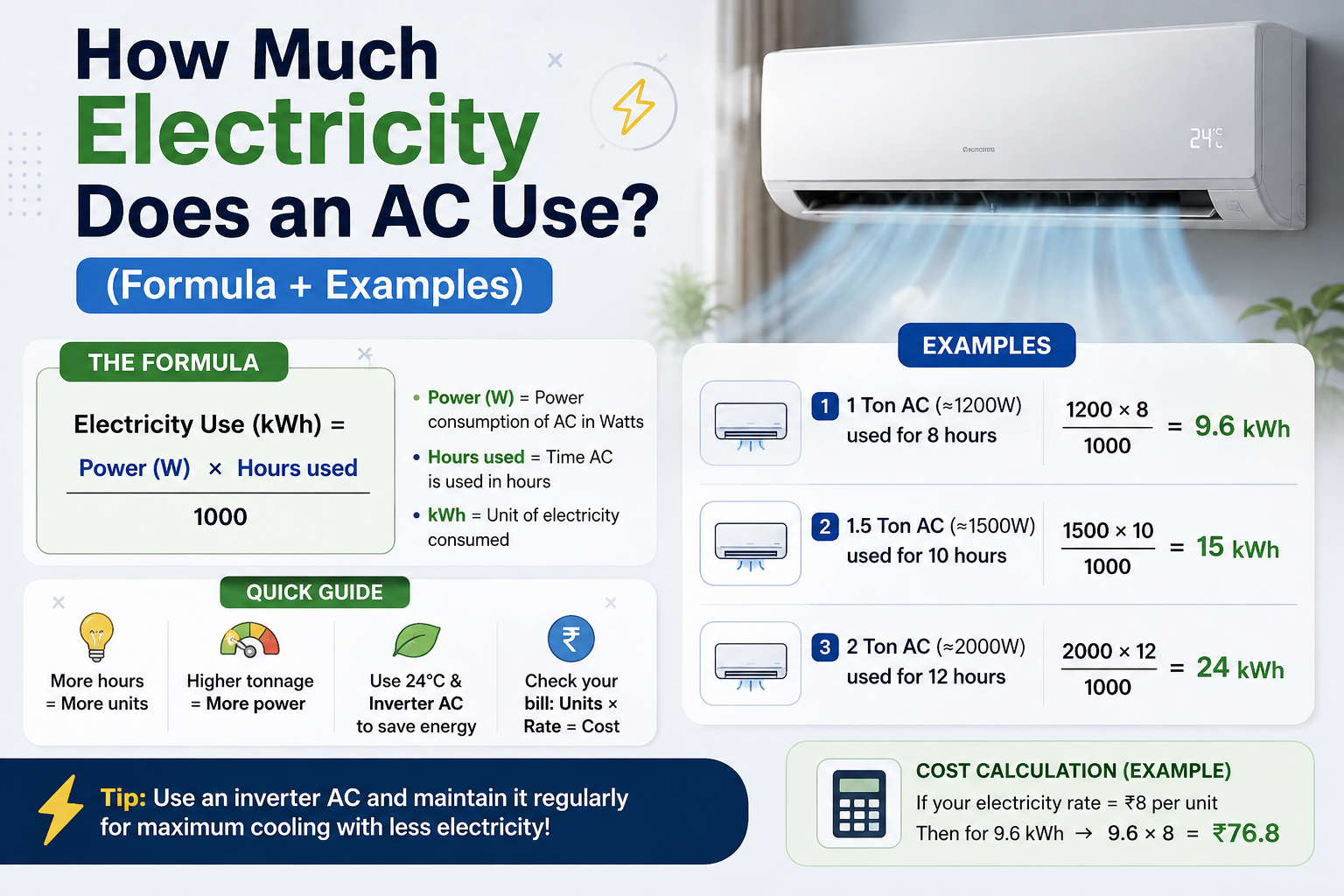
The basic formula for electricity consumed by any appliance is the same everywhere in the world:
For an AC, the "power in kW" is not the tonnage or BTU rating — it's the actual electrical input power, which you can usually find on the AC's rating label or in its user manual, listed as "power input" or "rated power consumption."
Electricity rates and units vary widely by country, region, and even by consumption slab or time of day. Don't rely on a rate quoted in one place — check the current rate on your own electricity bill or with your local provider before estimating cost.
Example Calculation
This is an illustrative example only — actual figures vary by AC model, region, and usage pattern.
Suppose an AC has a rated power input of around 1.5 kW, and it runs for 8 hours a day.
- Electricity consumed per day = 1.5 kW × 8 hours = 12 kWh
- Electricity consumed per month (30 days) = 12 × 30 = 360 kWh
To estimate cost, multiply 360 kWh by your local electricity rate per unit (for example, if your rate were $0.15/kWh, that would be roughly $54 for the month — but you should use your own actual rate, since rates differ significantly between countries and regions).
This is a simplified example. Inverter ACs rarely run at full rated power continuously — they cycle between higher and lower power draw depending on the cooling load, so actual consumption is often lower than this straight-line calculation suggests.
Factors That Affect How Much Electricity Your AC Uses
| Factor | How It Affects Consumption |
|---|---|
| Capacity | Larger capacity units generally draw more power, but an undersized AC for a large room may run longer and less efficiently |
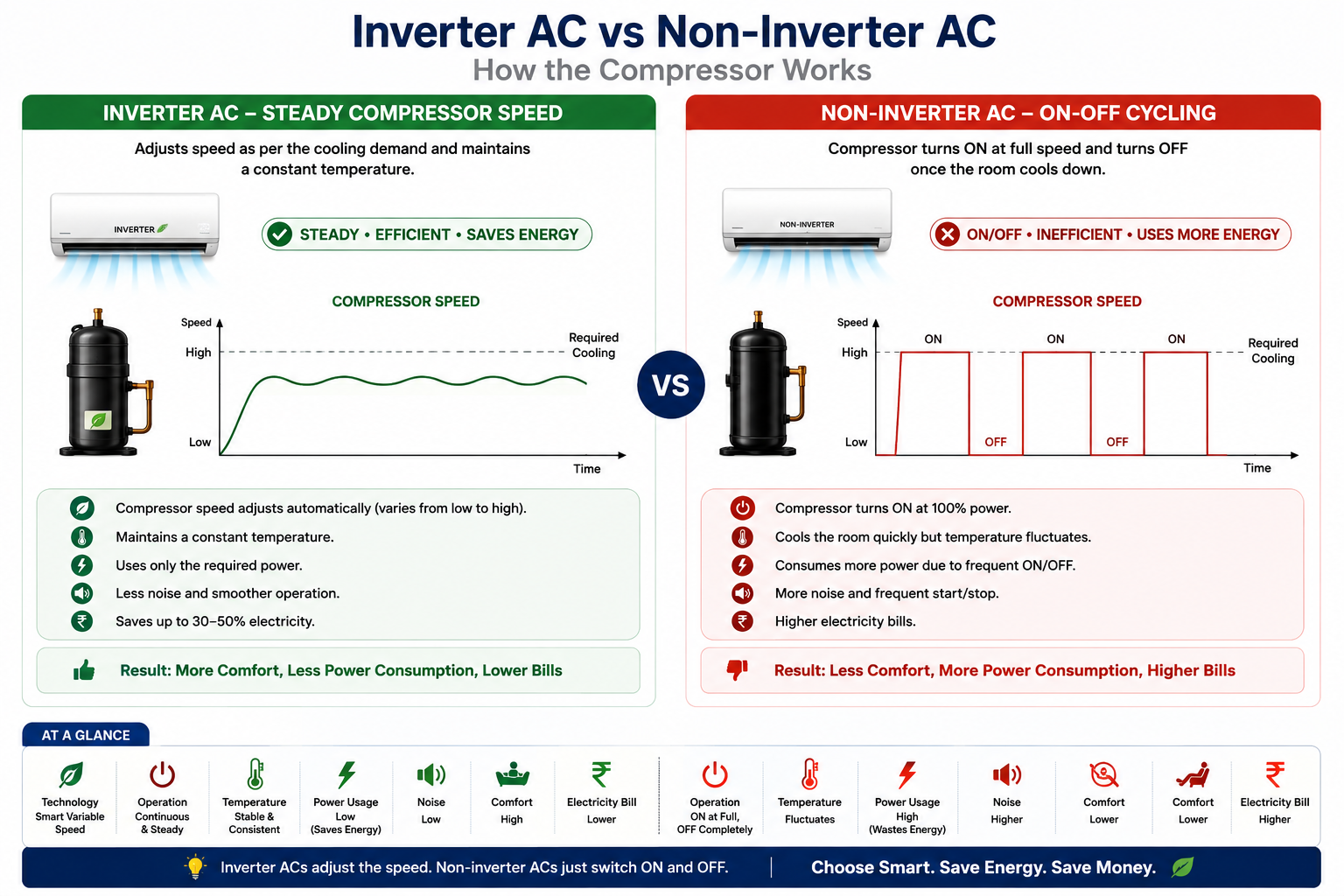
| Inverter vs non-inverter | Inverter ACs vary compressor speed to match cooling demand, often reducing consumption compared to non-inverter models cycling on/off at full power |
| Energy/star rating | Higher efficiency ratings indicate better performance for the same cooling capacity |
| Temperature setting | Setting the thermostat lower than needed increases compressor load and runtime |
| Room size and insulation | Poor insulation, uncovered windows, or gaps let cool air escape, making the AC work harder |
| Outdoor temperature and humidity | Hotter, more humid outdoor conditions increase the cooling load, which can affect runtime and consumption |
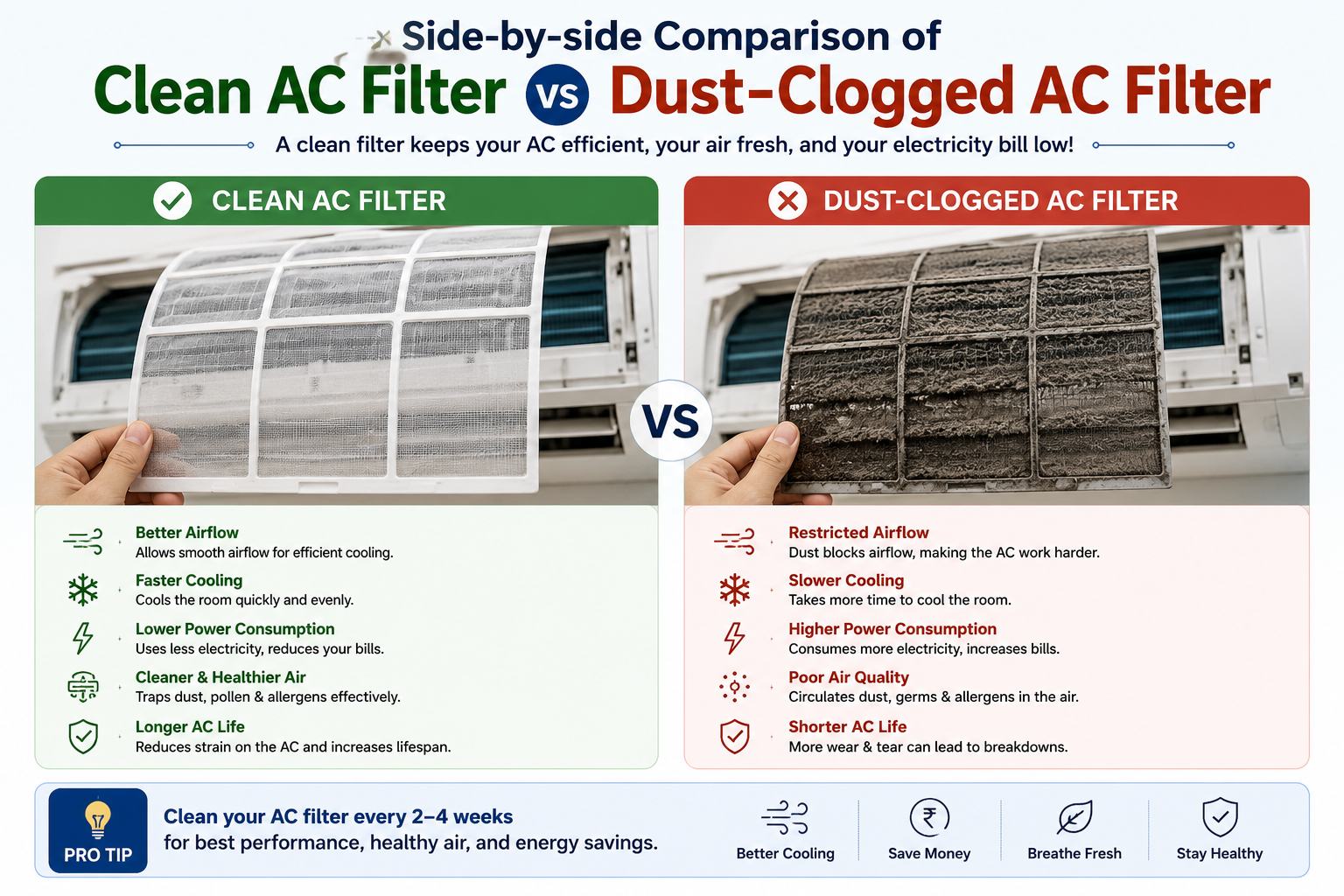
| Filter and coil condition | Dirty filters or coils restrict airflow and reduce efficiency, increasing electricity use for the same cooling output |
| Usage pattern | Frequent on/off cycling, especially with non-inverter ACs, can use more electricity than steady operation |
Does Inverter AC Really Save Electricity?
Inverter ACs are generally more efficient over typical daily usage because the compressor adjusts its speed to maintain the set temperature, rather than switching fully on and off. This usually results in lower overall consumption for continuous, longer-duration use, such as running the AC through the night or for many hours during the day.
For very short or intermittent use, the difference between inverter and non-inverter models may be less noticeable. The actual savings depend on usage pattern, AC condition, and how the unit is maintained.
Practical Examples of AC Usage Scenarios
- Running an AC overnight (8 hours) in a bedroom: Consumption depends on the AC's power rating and the set temperature. A well-maintained inverter AC set to a moderate temperature (such as 24–26°C / 75–79°F) typically uses less electricity than the same unit set to a very low temperature.
- Running an AC for a few hours in the afternoon: Shorter usage naturally reduces total units consumed, but a poorly maintained or undersized AC may still run longer than expected to reach the set temperature.
- Running multiple ACs in a home: Total household consumption adds up across units, so capacity, star rating, and maintenance across all units matter for the overall electricity bill.
Climate plays a role too. In hot, humid regions, AC usage tends to be higher during summer months and can also increase during humid periods when people use AC partly for dehumidifying comfort. High humidity can add to the cooling load, which is one reason well-insulated rooms and properly maintained ACs tend to run more efficiently in warm, coastal, or tropical climates.
Tips to Reduce AC Electricity Consumption
- Set the temperature to a moderate level (around 24–26°C / 75–79°F) rather than the lowest setting
- Clean or replace air filters regularly to maintain airflow
- Keep outdoor units and condenser coils clean and clear of debris, which matters especially in humid or dusty environments
- Use curtains or blinds to reduce heat gain during peak sun hours
- Seal gaps around doors and windows to prevent cool air loss
- Use ceiling fans alongside AC to improve air circulation, allowing a slightly higher thermostat setting
- Avoid frequent on/off cycling, especially with non-inverter units
- Service the AC periodically so it isn't working harder than necessary to cool the room
Common Mistakes That Increase AC Electricity Usage
- Setting the temperature far below what's actually needed
- Ignoring filter cleaning for extended periods
- Running the AC in a room with doors or windows left open
- Continuing to use an AC with a refrigerant leak or cooling issue, which forces the compressor to work harder for less cooling
- Not scheduling maintenance before peak summer season
When Professional Service May Be Needed
Some efficiency issues can be checked and improved by a homeowner, such as cleaning or replacing filters and keeping the outdoor unit area clear. However, several conditions are best left to a qualified technician:
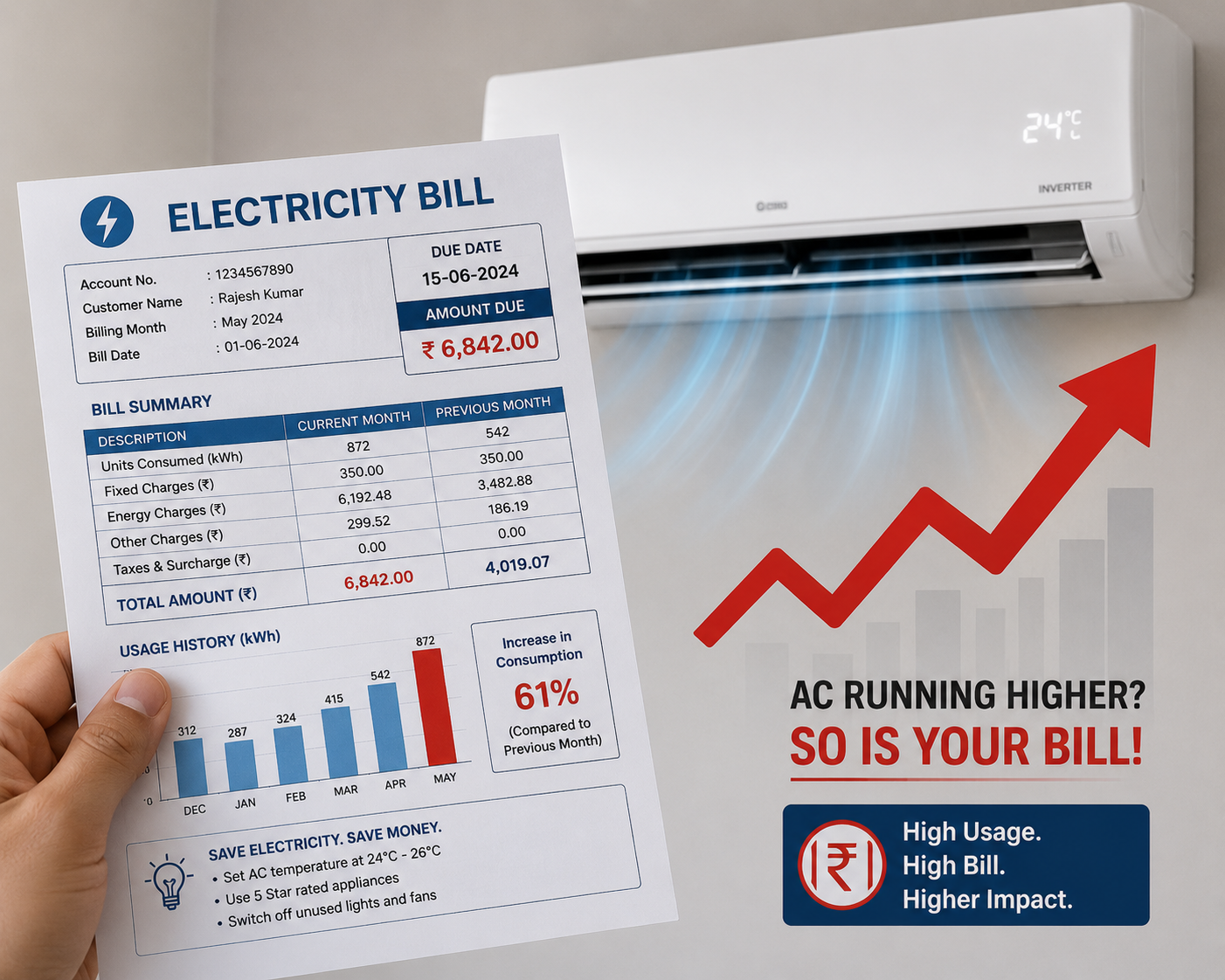
- Unusually high electricity bills without a change in usage pattern
- Reduced cooling despite normal settings and clean filters
- Ice formation on the indoor unit or pipes
- Unusual noises, water leakage, or a burning smell
- Suspected refrigerant leaks (refrigerant handling should never be attempted by a homeowner)
A professional can inspect the compressor, refrigerant levels, coil condition, and electrical connections to identify whether inefficient cooling is increasing electricity consumption. If you're facing persistent high AC bills or reduced cooling and are based in Goa, our team can inspect and diagnose whether the issue is maintenance-related or something that needs repair — wherever else you're reading from, a local qualified technician can do the same.
Based in Goa? Get a professional AC check-up.
If your AC electricity bills seem unusually high or cooling has dropped, our technicians can inspect the unit and identify the cause.
Book AC Service in GoaFrequently Asked Questions
Does an inverter AC use less electricity than a non-inverter AC?
Generally, yes, for longer or continuous usage, because the compressor adjusts speed instead of switching fully on and off. Actual savings depend on usage pattern and maintenance.
How many units does a 1.5 ton AC consume per hour?
It varies by model, star rating, and settings, but as a rough reference, many 1.5 ton (roughly 5kW cooling capacity) ACs draw approximately 1 to 1.8 kWh per hour at typical settings. Check your specific AC's rated power input for an accurate figure.
Does setting the AC to a lower temperature increase electricity consumption?
Yes. Lower temperature settings generally make the compressor work harder and run longer, increasing electricity use.
Does running the AC all night use significantly more electricity?
Total consumption increases with longer runtime, but a moderate temperature setting and a well-maintained AC can help keep overnight usage more efficient.
Does a dirty AC filter increase electricity usage?
Yes. A dirty filter restricts airflow, forcing the AC to work harder to cool the room, which can increase electricity consumption over time.
How can I calculate my AC's exact electricity cost?
Multiply the AC's rated power (in kW) by its operating hours to get kWh consumed, then multiply by your local electricity rate per unit, which you should verify from your electricity provider or latest bill.
Does humidity affect how much electricity an AC uses?
Higher humidity can add to the cooling load in some conditions, which may affect runtime. The exact impact depends on the specific AC and room conditions.
Final Takeaway
There's no single universal number for AC electricity consumption — it depends on the AC's capacity, efficiency rating, technology (inverter or not), temperature setting, operating hours, and how well it's maintained. Using the simple formula of power (kW) × operating hours gives a reasonable estimate anywhere in the world, and keeping your AC well-maintained is one of the most practical ways to keep consumption in check. If your electricity bills seem unusually high or your AC isn't cooling as expected, a professional inspection can help identify whether maintenance or repair is needed.